Showing posts with label embedding ethnography. Show all posts

June 26, 2019

Embedding UX

By Ned Potter, Academic Liaison Librarian 

At UXLibs IV, Michelle Blake and I presented on embedding UX at York and trying to make it part of our culture. We then wrote up the article for the UXLibs Yearbook, and the Open Access embargo period has now come to an end so please go and have a read! You'll find the article here in the White Rose repository, freely available to download.

UX methodology is becoming more firmly established in the Library sector, moving from novelty to maturity. The article focuses on how do we've tried to ensure that our internal processes, systems, and ethos support this, and make UX truly part of our daily ‘business as usual’, rather than being a perpetual project... 

If you're interested, our slides from the conference are here:


To give you a flavour of the UXLibs yearbook article, here's an excerpt:

Top tips for embedding UX at your own institution 


We thought we’d end with five tips for embedding UX. We’re not trying to suggest we’re the experts here, or that we’ve perfected our strategy. But we have gone a long way to make UX part of the culture at York, and here are some of the things we consider to have been most important in achieving that:


You need buy-in from the top. 

Of course you do, this is news to no one. The key is to link UX to the existing aims and strategy of your organisation and management. People are much less likely to buy in to something in UX silo than they are to buy in to something which helps them achieve what is already on their agenda. Persistence is important too. Many institutions have found it’s a lot easier to get permission to diagnose problems through ethnography than permission to try and solve them through actual design changes - but don’t be discouraged, keep suggesting ways to improve things, and celebrate successful changes widely - and publicly. Which brings us neatly to...

Go beyond the walls of your own institution. 

The more you shout about your UX work to the wider world, the more it is appreciated inside your own institution. In a strange way, external validation can influence how valid something is considered internally, and if your work is out there and talked about this can help enormously.

Repeat after me: UX is not cool. 

The sooner UX is no longer framed as this hip new thing, the better. UX is a suite of useful tools that enable us to better know our users and improve our services for them. Nothing about that is faddish. UX is not trendy; UX is essential to improving library services.

Time is SO important for UX. 

It is important to be realistic about just how much time UX takes. We’ve found the 4:1 ratio - the idea that for every hour of fieldwork you’ll spend four hours analysing and making recommendations - to be remarkably accurate. It’s a messy business, ethnography, and only worth it because of how incredibly productive it can be. Investing time in staff so that everyone feels like they can truly understand and utilise these techniques is important. Time to keep up to date through networking at events, attending presentations, and reading the literature. Time for each project. Time to analyse results. Time to act on the data.

You get more impact from quality than you do from quantity. 

Embedding UX at an institution is not about trying to crowbar it into every facet of working life, in fact the opposite is true. Focus the way you use your resources and aim for true impact on the users of your service.

 UX truly takes root not because you do it all the time, but because when you do it you make a genuine impact, you truly learn, and things change as a result.


If you'd like to read the rest of the yearbook article, please download the article here!

November 19, 2018

[Video] UX keynote all about ethnography and design at York

By Ned Potter, Academic Liaison

This month I had the honour of giving the opening Keynote at the Stellenbosch University Library Symposium, the theme for which this year was User Experience.

I've travelled to South Africa for a conference before and it was one of the best professional experiences I've ever had, but this time I couldn't quite make the huge journey time work, with it being Autumn term, so we decided to do it virtually. We chose a mixture of recorded and live - I created a video, using Screencast-o-matic which I love, and then we did the Q&A live via Skype. I thought this was safer than trying to do the whole thing live and risk technology failure...

Although my colleagues and I have talked about UX at various events over the last three years, this was the first time we'd had the length of time afforded by a keynote, and my hosts had specifically asked to hear about the projects we've done at York - so essentially I pulled together all threads we often write about on this blog into one big presentation. I've embedded the video below and of course you're more than welcome to watch the whole thing if you'd like to! But given that people often have specific areas of interest around UX, here are some shortcuts to the various parts of the presentation:
  1. After the preamble there's an introduction to UX and ethnography. What it is (and isn't), the way it has spread across the industry, why it's so powerful. 
  2. Part 2 is a A timeline of UX at York. I discuss the various major UX-led projects we've done, our use and non-use of interns to help us, and the various ethnographic techniques we've used
  3. The massive up-scaling involved for the Understanding Academics project, plus some of our findings and the changes we made, are discussed next
  4. How we try to disseminate our findings and experiences is covered here
  5. Next I cover steering and guidance for UX. How it fits strategically, our UX Group which includes our UX book club, and so on
  6. Training and Support for UX is discussed here: our internal training sessions and the way we've been trying to bring this techniques to other parts of the University
  7. Finally, some tips for embedding UX at your own institution

There were some great questions afterwards not captured by this video. One of them was around the use of interns and the pluses and minuses of this. At York our first two UX projects were intern-led and we found this hugely beneficial for a number of reasons: someone having the time and space to focus on the fieldwork and analysis without other distractions was part of it, but so was having a completely fresh pair of eyes involved. There are advantages to non-library staff speaking to users as part of the fieldwork and bringing an outside perspective to the design recommendations.

That said, we did all the fieldwork for our two biggest UX projects to date ourselves, partly because it was such a good opportunity for as as staff to be learning about our users first-hand. It's also a fascinating process to be part of and a good opportunity for staff to learn new skills.

So without wanting to sit on the fence, there are good arguments both for using interns and for doing everything yourself...

______________________

Thank you so much to everyone at the Conference for inviting me and allowing me to present virtually. It was fun to put together.

November 06, 2018

Building the Fabrik Wall

By Ned Potter, Academic Liaison Librarian 

At the start of the academic year we reached a significant milestone in our use of UX at York (about which you can read many, many more posts elsewhere on this blog). We made our first major purchase as part of a re-design that came directly from an ethnographic project - woohoo!

We bought a sound-absorbent wall made of 'Fabriks' - it works like giant Lego, looks pretty cool, and controls the acoustics of the environment around it.

Here's what it looks like:

The Fabrik Wall as seen from the front

The Fabrik Wall as viewed from 'inside' it
To get the context to all of this we need to go back to 2017.

The UX Space Project

During 2017 we undertook the UX Space Project: ethnographic User Experience research into how the Morrell Lounge is used and how it might be improved. This is the area you see as you enter the Library at York - on average around 3,000 people pass through this every single day, making it perhaps the busiest area on either campus. At peak times there's around 7,000 entries.

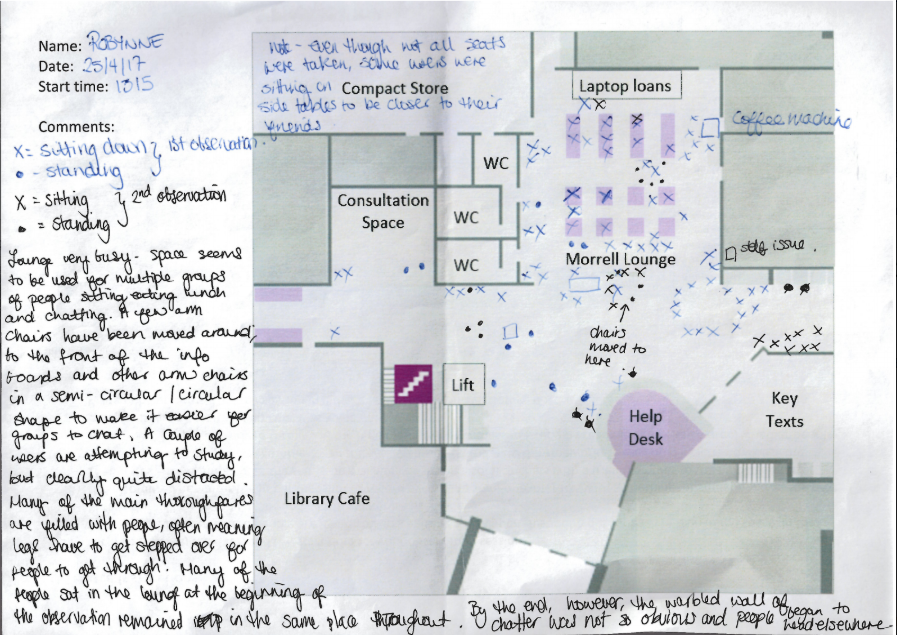
The fieldwork consisted of more than 40 sessions of behavioural mapping. We actually had to modify the 'standard' way we'd done observation like this before, because the area was simply too busy to track people's routes through the space. That element was removed from the list of responsibilities, but we made other tweaks too: for the first time we used a template map of the space (based on our floorplans), we put a definition of the AEIOU framework on the back along with other guidance to remind people what they were looking for, and left space for notes on the map itself.

Here's an example of the map and notes from one observation session:


A behavioural map with notes 
The fieldwork was undertaken by Customer Services staff (each of whom had individual training before their first session) and they were absolutely brilliant at capturing key info, and then feeding into the design process to find solutions too. All CS stuff kept notes of their thoughts on the space when working at the desk too, so we built up a picture of how the area was used even on days when we didn't have a Behavioural Mapping session planned. This turned into a massive 19-page Google Doc, which also included feedback from students and staff as it came in.

The initial phase of fieldwork lasted 6 months. The project identified problems including the area being too loud for those wishing to seek guidance at the Help Desk, it being unsightly to visitors as students are sprawled on the floor, and fundamentally the space not being used as we intended.


Design Prototyping

We ruled out trying to change the way the space was used, early on in the process. Instead we wanted to change the space to better suit the way it has been adopted by students and staff: this included swapping furniture with other areas of the Library to suit the way people congregate in groups, which was our first proper attempt at design prototyping. The changes we made went down so well, getting so much positive feedback (we had people emailing the library just to tell us how much they liked it!), that following another round of observational fieldwork we ended up leaving the temporary furniture in situ. It's still there now, although long term we'd like to improve the space further - we have a full design ready to go, based on all the research and suggested changes we've come up with, but it will cost a lot of money to realise.

Most costly of all we really wanted some kind of acoustic baffling to both contain the sound and make the entrance lobby a visually arresting sight with which to greet our regular users and visitors. We went through several rounds of a bidding process to try and win some Alumni funding to make big changes to the space - in the end the 'YuFund' scheme provided us with the funds to purchase what we're calling the Alumni Wall that you saw at the start of this post, made of special sound-absorbent ‘fabriks’ to change the acoustics of the space. And the acoustic difference is absolutely remarkable, significantly reducing the noise spilling from the Lounge, and in particular better enabling staff and students to converse at the Help Desk. Many staff have commented on the effect this has had - it is now noticeably easier to help people with queries - and the students like it too: ’Wow I really like it!’ one returning student exclaimed, coming to the desk especially to tell us… It also looks fantastic, and gives the whole area a more cohesive feel.

The whole project felt really exciting to be part of. It involved people from different teams in the Library working together, which is always good, and the Alumni Office (and the Students' Union) were really enthusiastic about what we were doing. Ultimately we were able to make a significant change to the space, and overall it works much better for both students and staff than it ever has before.

Finally, here's a short time-lapse video of its assembly:


March 15, 2018

RLUK presentation: Understanding Academics

Today I'm presenting at RLUK about our 18 month UX project, Understanding Academics. We're really proud of this project and what we've achieved with it. This speed presentation aims to provide an overview of the project and what it achieved.


We've already written about our UX activities a lot including this project. If you're interested you could look at some of our previous posts including our first post on the project, Understanding Academics UX project, and one detailing how we actually dealt with all the data the project created, Processing and ACTING ON 100+ hours of ethnography: a 5 stage approach.

There are also lots of other posts about our UX activities and we are in the process of writing an article which, when published, will be linked to from here.

And as always if you want to know more please get in touch with us.

Our article has now been published and you can view it for free via the White Rose Repository.

September 26, 2017

"The library blankets are lush, grab one"

By Ned Potter

I've had a number of emails recently asking after our blankets in the library. So I thought I'd write a post about it here.

Getting blankets for the library is probably one of the best things I've ever done in libraryland, honestly.  It took almost no effort and very little money. The students LOVE them. Everyone's a winner.

The quote in the title is from our feedback board where we asked students for tips for their peers. Here are some other quotes from the Graffiti Wall and from Twitter:


So the short version of this post is, get blankets in your library! It's 100% worth doing.

Practicalities 


We bought 30 blankets for each of our sites. We get them from a local laundry who also launder them for us - but you can also buy perfectly serviceable and cheap examples from for example IKEA if you have your own laundry service to hand. They're laundered termly unless there's a reason to bring that schedule forward... 

They sit in a bucket near the entrance of each library, and people can help themselves to them as they come and go. Here's a picture of the main campus library blankets: 
You'll notice the blankets are a fairly drab grey - this is deliberate, to make them less tempting to abscond with...

Origins 


Like all academic libraries, our number 1 complaint for users is about the temperature - and it's equally split between too hot and too cold most of the time. We don't actually control the temperature anyhow, so we adopted the UX mentality of 'if you can't fix the problem at least make the user experience better in any way you can' and tried to improve things in what small ways we could. 

We'd heard at UXLibs I that a college in Cambridge had given out blankets and that this had reduced their complaints about the cold. Some students of mine from the History of Art Department came to me as part of Library Committee and told me it was basically too cold to work in Kings Manor, our town centre site which is in a building several hundred years old, so I immediately thought back to what Cambridge had done and resolved to steal their idea... (Sonya Adams and Libby Tilley at Cambridge were both really helpful to me in advising on how to set this whole thing up.) 

The students involved were really pleased but the great thing is EVERYONE was really pleased. 

So as we head into the colder months, see if you can do this for your library. Or even better, get your students SLANKETS so their arms are still free for reading. :) 

June 27, 2017

UXLibsIII: impressions of a novice

By Vanya Gallimore, Academic Liaison Team Manager

First time attending the UXLibs conference and it was, quite simply, phenomenal! I've heard so much about the previous conferences (everyone seems to come away completed exhausted and inspired) but I've never been able to attend myself until this summer. Turns out, it really is exhausting and inspiring...and so much more.

We've been busy doing UX activities at York for the last two years and have written various blog posts about our work. We've tried a range of techniques including love-break up letters, cognitive mapping and semi-structured interviews, but what struck me at the conference was how much more there is to learn and put into practice. People came to the conference with lots of new ideas and their experiences of what works (and sometimes what doesn't work, which is always interesting to hear too). The conference is hugely international, with the Scandinavians leading the way on a lot of UX innovation, and it was fascinating to learn more about the reach of UX in libraries across the globe.

There were some key take-home messages:
  • The importance of being able to articulate what UX actually is in a succinct and meaningful way to get engagement from your institution: rich and deeper knowledge of user experience (Andy Priestner).
  • UX works well when you get everyone involved, not just one or two individuals in an organisation. How can we democratise UX and truly empower teams?
  • We need to understand that the services we offer in our libraries reflect our core values. When we build things, we want them to be expressions of US, of our values. Our expertise, our service ethic and our values remain our greatest strength.
  • Ethical design matters hugely: how will the objects that you design affect your users? When we create products and services, we need to really care about who is actually going to be using those products and services.
  • Never make assumptions about how your customers use your services!
And some things that we would definitely like to consider taking forward at York:
  • UX meets information literacy: getting students to use capture technology to record themselves using the library catalogue to find resources for a specific assignment. They don't use the catalogue in the way that you expect them to - at all!
  • Idea originally from Manchester: "If students did libraries..." what changes would they make to improve the library experience?
  • Visitor and resident mapping exercise to understand use of, and engagement with, digital tools.
  • Design Think: how can we introduce new design thinking methodologies into our planning processes and practices?
  • Creating effective personas that take the data about our users, humanise it and communicate patterns of behaviour to other people, while still reflecting the complexity of users.
So, there is a lot to think about and trial out over the coming year, and I'm really excited about the ongoing opportunities that UX presents to really understand and improve the user experience for all our users at York.

For my part, I gave a presentation about the Understanding Academics project that we have been doing over the past eighteen months, focussing on how we managed all the data associated with such a large-scale project. We're nearing the end of that project and will be posting our final conclusions and next steps shortly. It's just one of many, many UX projects taking place globally and I'm grateful to UXLibs for bringing some of these together and allowing us all to learn from each other. Here's to UXLibs IV...


May 29, 2017

Sharing UX findings: a strategic approach

By Ned Potter, Academic Liaison Librarian 

This is the 30th post in Lib-Innovation, to it seems appropriate to celebrate the milestone by talking about dissemination of our UX work at York. Although this blog covers lots of other things too, the topic of UX was the main reason we created it in the first place.

We've tried to take a strategic approach to dissemination, proactively looking to share what we're doing with as many different types of audience as possible rather than just hoping it will happen. We're excited by what we're learning both from and about the ethnography, and the design, that we're undertaking, so we want people to know about it. In the ideal scenario, we'd spark ideas off that others take on and apply in their own contexts. And we want feedback and ideas to improve our own work. So we're telling people about the work across multiple platforms, and in this post we'll explore some of the ways we're doing it, and why.

Internal audiences

Our rule of thumb is that anyone who gives their time to take part in our ethnographic fieldwork should be the first to hear what we've done with the information. So for the last major UX project we did, the 100 or so participants go an interim report (along with library managers), and they will be the first to see the final report, before it is more widely circulated within the University. 

The Library industry in general

The blog is open and anyone can read it, but it is aimed primarily at those in the library industry. (There's a separate blog which we aim at staff and students who use the library.) We hope to reach as many people as possible this way. Not everyone will end up caring too much about UX but hopefully for some it will stick. We put pretty much everything on here - the idea is you don't have to be at a certain event or to speak to any of us in person to learn everything there is to learn about what we're doing.

I tweet about it, we ask the people in the University's Central Marketing who deal with the library to tweet about it, and I sometimes reblog UX articles on my own website.

We've been pleasantly surprised by how much people have read the posts: the most popular article on this site (Vanya Gallimore's overview of our Understanding Academics UX project) has been viewed over 1800 times at the time of writing, which is more than the readership of the majority of subscription journals. What we've not had, however, is comments! I love blog comments. There was a period around 2011 or so when everyone left comments on each other's blogs, and as an author of a post it was so gratifying to be able to interact with people reading. That doesn't seem to happen any more (or maybe that's just our blog!), which is a shame.

We've also presented at a couple of non-UX related library events, for example at the Libraries, Archives and Museums Marketing Awards organised by the Welsh Government.

The Library UX community in particular

An obvious avenue for sharing our UX findings is conferences aimed wholly at libraries interested in UX. With that in mind I presented an overview of our UX activities so far at the Northern Collaboration Library UX event earlier in the year, and Vanya will be presenting at UXLibs III, the biggest conference in this area, in June. My colleague Martin Philip will also be soliciting feedback on our work so far during the UXLabs part of that conference, where delegates share work in progress.

UX Specialists from outside the world of libraries 


We've only done one talk in this category so far but it's been incredibly beneficial. I presented to the Human Computer Interaction research cluster in York's Computer Science Department. There is a huge amount of knowledge and experience in the area of UX there, not just in terms of academic research but a lot the academics spend time in industry too.

They have a regular seminar series so we asked if we could take a slot in it. We approach this opportunity a bit like we'd approach a UX project: we didn't have a specific agenda or goal in mind but we were pretty sure we would learn something useful. My talk was very much 'here's what we've done, what would you advise we do next?' and it turns out they had a lot of extremely useful advice. I ended up writing pages of notes from the discussions that happened during the talk and afterwards.

A slide from the Computer Sciences presentation

Among many positive outcomes, that particular day ended up shifting our future approach to UX to a less generative and more evaluative research process, to us changing the way we deal with customer profiles and personas entirely, to us putting together a bid (still in progress) for an intensive design workshop, and to the Department kindly offering to allows us use of their eye-tracking software for future projects. We hope to speak to more non-library audiences in the future. Talking of which...

Audiences outside HE and libraries entirely

I was invited by the Good Things Foundation, a charitable organisation who do a lot of work around digital inclusion and with public libraries, to talk to their staff at their Sheffield HQ. It was a great opportunity to exchange views and experiences with a completely different group of people, facing different challenges. 


And finally: Slideshare 

I used to love Slideshare as a dissemination method. Recently however it's gone from being brilliantly useful to rather more hit and miss. It's always great for uploading your slides for others to find, and that can lead to all sorts of opportunities. But until recently Slideshare would 'feature' around 10 slidedecks each day on its homepage - if your slides got selected for this it would boost the views by 20,000 or so. Because of this it has a reach that we can't hope to match by any other channel. We have a lot of methods listed above which are about reaching quite specific audiences; Slideshare was our way just to reach far and wide and hope some relevant people were among the inflated audience.

In the last year or so Slideshare have stopped regularly updating their homepage, so the chance to get featured has reduced almost to zero. The overview of our UX activities so far hich I presented at Northern Collaboration has not been featured, but nevertheless 3,200 people have viewed it at the time of writing. My slides from the LAM Awards event mentioned above DID get featured however, and in fact as still there on the homepage of Slideshare, three months later. As such they've now been viewed just over 285,000 times, which is ridiculous. Clearly only a small fraction of those people are relevant to us at York.

Slideshare stats

However, 1,751 people have downloaded the slides, suggesting they want to study what we've done a little closer. And these slides led directly to the invitation from the Good Things Foundation, as well as a visit to York from librarians overseas to discuss our UX work - so although Slideshare's reach is unfocused, it's still been relevant and useful for us.

April 19, 2017

Northern Collaboration User Experience (UX) Learning Exchange 2017


 By Robynne Eller, Assistant Librarian


“What people say, what people do, 
and what they say they do are entirely different things”


- Margaret Mead

The Northern Collaboration UX Exchange took place at the University of Huddersfield's state-of-the-art archive facility at the Heritage Quay. The choice of venue offered the perfect setting for a creative day of discussion and the chance to showcase a selection of what some Northern universities have been up to in terms of their approach to UX in their libraries.

#NCLXUX - Review of the day:

A wide range of UX topics were covered during the Learning Exchange, presentations given by speakers from institutions across the north of England. The day was introduced by UX expert, Andy Priestner, who reiterated the benefits of UX in university libraries, as well as breaking down the barriers of users who believe they are “Not good at libraries".

Some of the topics from other speakers surrounded usability issues of library websites, UX for distance learners, to the use of ethnographic studies used to observe user behaviour and use of space in academic libraries. Some of the talks given on the day can be found on Slideshare, which offers a snapshot of some of the themes and projects discussed. Storify was also used to show all Twitter feeds during the event, which were buzzing throughout the day!
Using social media to keep the UX conversations going!


A major theme that ran through the talks, was how ethnographic survey methods, specifically attitudinal surveys and behavioural mapping was used, in order to help understand users at a deeper level. For instance, at Teesside University, behavioural and cognitive mapping (as well as a Twitter photo competition!) helped inform how library furniture was used, showing furniture was being used in somewhat different ways by users than originally envisaged!

Communicating with users using social media: Teesside’s photo competition


It was also great to see that most of the universities were communicating with users through means of a “graffiti” or “feedback” wall, which have proved to be very responsive and positive in all cases where it has been utilised. Insights from the Open University were also quite useful in terms of their outreach to users who would access their services remotely, rather than visiting their library in person. From all the presentations given, it was clear that even smallest of UX changes held a significant impact for users and one of the key messages in achieving such changes is to not fear failure.


We even created our own graffiti walls to share UX ideas!


Following the talks, one of the most enjoyable aspects of the days was the opportunity to have open discussions with a range of other library staff from other HEI libraries. Seeing different projects from a range of different institutions made for some interesting discussions which enabled us to share ideas, be informed and inspired. We were also given a tour of the archives at Huddersfield, which was an excellent finish to the day!

Strategic Marketing in academic libraries?

It was enlightening to see how academic libraries are viewing UX as a marketing exercise, both in terms of research approaches and consideration of the a library’s long-term marketing cycle. I believe that this allows institutions to showcase what they are really good and marketing services which hold value for its users.

Additionally, such approaches allows academic libraries to keep their services fresh, relevant and exciting whilst continuing to have regular conversations with their users and colleagues to continually improve. Applying such an approach allows for specific questions to be asked and for users to be heard, so a suitable response can be made. As such, from the presentations, it is clear that a range of ethnographic methods are vital in achieving a better understanding in what users need most from their library services.


UX at York: What are we doing?
We've make quite a number of tweaks as a result of ramping up our UX recently, which did not go unoticed during the UX at York talk. But what are we doing now? As a part of the UX Space Project, we have recently been carrying out a series of ethnographic surveys in the Morrell Lounge and Raymond Burton study space. The aim of carrying out this type of survey is to gain a better understanding how spaces within the Library are used, the data of which is hoped to inform further stages of the Space Project.


The observations will be carried out over a twelve month period from February 2017 by staff members from IT, IS and CSA teams in 15-minute observations once a week per team. Within each 15 minute slot, user activity is observed and marked on floor plans using the AEIOU framework and changes to activity or new interactions are subsequently noted. Notes and thoughts are typed up later. Further to our observations, we have also asked staff members who notice spaces being used in a particular way at other times to report these to the UX Space Project group.

 
Example of an observation plan

Robynne’s take home messages:

  • Even small tweaks to a service can be significant
  • There is no such thing as “I’m not good at libraries”
  • Attitudinal surveys and behavioural methods are particularly useful when used in tandem with one another
  • Do not be afraid to fail
  • Ethnographic studies can be used to inform bigger changes

I would recommend anyone interested in UX to attend any collaboration events to keep up to date with what's going on in the world of UX. Seeing how York implements strategies within a Northern context was very informative - it will be exciting to see what the future holds for UX in libraries in the North and the rest of the UK. Huddersfield was also a great host for the event and I particularly enjoyed the tour of their archives too afterwards!