Showing posts with label uxlibs. Show all posts

June 26, 2019

Embedding UX

By Ned Potter, Academic Liaison Librarian 

At UXLibs IV, Michelle Blake and I presented on embedding UX at York and trying to make it part of our culture. We then wrote up the article for the UXLibs Yearbook, and the Open Access embargo period has now come to an end so please go and have a read! You'll find the article here in the White Rose repository, freely available to download.

UX methodology is becoming more firmly established in the Library sector, moving from novelty to maturity. The article focuses on how do we've tried to ensure that our internal processes, systems, and ethos support this, and make UX truly part of our daily ‘business as usual’, rather than being a perpetual project... 

If you're interested, our slides from the conference are here:


To give you a flavour of the UXLibs yearbook article, here's an excerpt:

Top tips for embedding UX at your own institution 


We thought we’d end with five tips for embedding UX. We’re not trying to suggest we’re the experts here, or that we’ve perfected our strategy. But we have gone a long way to make UX part of the culture at York, and here are some of the things we consider to have been most important in achieving that:


You need buy-in from the top. 

Of course you do, this is news to no one. The key is to link UX to the existing aims and strategy of your organisation and management. People are much less likely to buy in to something in UX silo than they are to buy in to something which helps them achieve what is already on their agenda. Persistence is important too. Many institutions have found it’s a lot easier to get permission to diagnose problems through ethnography than permission to try and solve them through actual design changes - but don’t be discouraged, keep suggesting ways to improve things, and celebrate successful changes widely - and publicly. Which brings us neatly to...

Go beyond the walls of your own institution. 

The more you shout about your UX work to the wider world, the more it is appreciated inside your own institution. In a strange way, external validation can influence how valid something is considered internally, and if your work is out there and talked about this can help enormously.

Repeat after me: UX is not cool. 

The sooner UX is no longer framed as this hip new thing, the better. UX is a suite of useful tools that enable us to better know our users and improve our services for them. Nothing about that is faddish. UX is not trendy; UX is essential to improving library services.

Time is SO important for UX. 

It is important to be realistic about just how much time UX takes. We’ve found the 4:1 ratio - the idea that for every hour of fieldwork you’ll spend four hours analysing and making recommendations - to be remarkably accurate. It’s a messy business, ethnography, and only worth it because of how incredibly productive it can be. Investing time in staff so that everyone feels like they can truly understand and utilise these techniques is important. Time to keep up to date through networking at events, attending presentations, and reading the literature. Time for each project. Time to analyse results. Time to act on the data.

You get more impact from quality than you do from quantity. 

Embedding UX at an institution is not about trying to crowbar it into every facet of working life, in fact the opposite is true. Focus the way you use your resources and aim for true impact on the users of your service.

 UX truly takes root not because you do it all the time, but because when you do it you make a genuine impact, you truly learn, and things change as a result.


If you'd like to read the rest of the yearbook article, please download the article here!

June 06, 2018

Embedding UX and Ethnography at York

By Ned Potter, Academic Liaison Librarian

Michelle Blake and I presented at the amazing UXLibs IV Conference today, about our approach to trying to move into a more mature phase of UX - something truly embedded in the culture, rather than a bolt-on, a silo, or a fad.

I've adapted the slides below slightly to include more text on screen - hopefully this gives you some idea of how we've gone about things. Any questions, we're very happy to talk about it more...


September 26, 2017

"The library blankets are lush, grab one"

By Ned Potter

I've had a number of emails recently asking after our blankets in the library. So I thought I'd write a post about it here.

Getting blankets for the library is probably one of the best things I've ever done in libraryland, honestly.  It took almost no effort and very little money. The students LOVE them. Everyone's a winner.

The quote in the title is from our feedback board where we asked students for tips for their peers. Here are some other quotes from the Graffiti Wall and from Twitter:


So the short version of this post is, get blankets in your library! It's 100% worth doing.

Practicalities 


We bought 30 blankets for each of our sites. We get them from a local laundry who also launder them for us - but you can also buy perfectly serviceable and cheap examples from for example IKEA if you have your own laundry service to hand. They're laundered termly unless there's a reason to bring that schedule forward... 

They sit in a bucket near the entrance of each library, and people can help themselves to them as they come and go. Here's a picture of the main campus library blankets: 
You'll notice the blankets are a fairly drab grey - this is deliberate, to make them less tempting to abscond with...

Origins 


Like all academic libraries, our number 1 complaint for users is about the temperature - and it's equally split between too hot and too cold most of the time. We don't actually control the temperature anyhow, so we adopted the UX mentality of 'if you can't fix the problem at least make the user experience better in any way you can' and tried to improve things in what small ways we could. 

We'd heard at UXLibs I that a college in Cambridge had given out blankets and that this had reduced their complaints about the cold. Some students of mine from the History of Art Department came to me as part of Library Committee and told me it was basically too cold to work in Kings Manor, our town centre site which is in a building several hundred years old, so I immediately thought back to what Cambridge had done and resolved to steal their idea... (Sonya Adams and Libby Tilley at Cambridge were both really helpful to me in advising on how to set this whole thing up.) 

The students involved were really pleased but the great thing is EVERYONE was really pleased. 

So as we head into the colder months, see if you can do this for your library. Or even better, get your students SLANKETS so their arms are still free for reading. :) 

July 26, 2016

UXLibs II Reflections

By Martin Philip, Academic Liaison Librarian 

On 23-24 June, I attended UXLibs II, an international User Experience in Libraries conference. Here are my reflections... 

WP_20160706_17_48_58_Pro.jpg
Ironic name badge

Welcome - Andy Priestner


“We need trained anthropologists and designers.”

Andy is very much the brains behind UXLibs and opened the second conference by providing some background to the work he has done at the University of Cambridge. Initially the type of research he was engaged with was dismissed by some academic colleagues and the work was often criticised. When Andy (and team) were looking at different types of furniture used in Library spaces, some labeled it ‘The Beanbag Project’. His team, were seen, by some, as people who spend too much time using Post-Its and also regarded UX and some of the techniques as merely another ‘emperor's new clothes’.
Andy explained that the challenges he faced getting the use of UX techniques off the ground were the same kind of challenges facing the rest of the world (i.e. ownership, territories and empire). Cambridge is a notoriously conservative environment where it is far easier to criticise and pick fault than to engage. 

One success they’ve had in the last year is spacefinder.lib.cam.ac.uk – ‘the website that wil change your studying life forever!’ is how one student described it. Spacefinder was aiming to help Cambridge students who were regularly struggling to find spaces matching their study needs and preferences. The end result is a kind of TripAdvisor for study space.

As Andy finished opening the conference, he proclaimed ‘Live with uncertainty and embrace UX!’ We would rather be wrong than uncertain so let’s prove it by research.

Keynote 1 – Donna Lanclos

Donna spoke last at the first UXLibs but was so good she got invited back! Donna is an anthropologist (at UNC Charlotte) working with ethnographic methods and analysis to inform and change policy in HE at large not just libraries.

Donna believes that UX work that has ‘failed’ (or ‘derailed’) can arguably be more important than ‘nailed’ due to the lessons learnt. She applies her mother's gardening philosophy to much of her work – plant what you think might work - if it dies, don’t plant it again. You try something because something needs to be done. Caveat – sometimes the plant dies because of you. Donna believes it’s important to figure out where the failure lies. In the places we work, in HE/ Libraries, there are people that have been around long enough to remember all the failures. She also suggested that some of us (delegates) can say we wouldn’t be here today unless we’ve had a moment in our life where we had been thoroughly derailed. A criticism she points at Library conferences, which I think I agree with her on, is that the talks are full of ‘yay me’ and not enough about failure.

Donna points out that, in ethnographic research, so often you can’t fix things, which can feel frustrating, however it doesn’t mean you’re not doing things. She feels, and there is definately something in me that thinks this way, that a major challenge is that Libraries want to fix things however she deems this obsession as ‘rigid solutionism’ that can sometimes stifle other types of research. She explains that ethnography is about gathering a different understanding of what is going on around and not just being fixated by numbers. She asked the question, ‘How do we get people to trust us and these practices?’ I guess it was kind of rhetorical or up to us to answer in light of our context but she continued by saying that our methodology will not save us from what she refers to as ‘the culture of libraries’. And provocatively asked what would our libraries look like if all our research was qualitative?!

In her applied work, which is what Donna does for a living, she makes the point that it becomes necessary to stop collecting data. Some of Donna’s archaeologist friends spend their entire time talking about their methods and data and leave no time for interpretation and meaning. At some point we need to make changes.

Donna asks ‘What is action?’ It can be, describing and interrogating formal structures. Leaders need to be on board (and leaders aren’t just the people at the top). Organisations need to allow for change she said and if we think about who the leaders are - she proclaimed to an unsure room that we’re all leaders! And that’s why we’re at UXLibs! We need to aim to create space for change and a toleration for risk.

Donna finished by talking about ‘networked leadership’. We are more powerful at effecting change if we (delegates) are working together. This became a theme of the conference, certainly from my perspective, the need to pool each other's resources no matter where we are based. I think it was this type of encouragement that led myself and 3 other delegates (from Hull, Roskilde and Kristiansand) to set up a Whatsapp group to keep in touch and share what we’re doing UX-wise and who knows, maybe work on something together in the future.

Keynote 2 - Lawrie Phipps

By his own admission, Lawrie was new to this world of librarians however he coped well! Lawrie’s works in HE predominantly in the area of change management so he brought an internal (HE) but external (of libraries) perspective to all this UX stuff which I think is needed.

I felt Lawrie’s key message was one of encouragement that everyone has the ability to enact change no matter what we’re doing and where we’re at. He cited Dave Brailsford, known for his work with British Cycling. His focus was to make 1% gains everywhere he could imagine and the cumulative effect of all these incremental changes/ ‘marginal gains’ soon became transformative leading to Team GB topping the cycling medal tables in 2008 and 2012 Olympics.
He encouraged us not to compromise with our ideas especially around UX, that is the job of our managers!
Lawrie, like Donna, talked about change, in your organisation, happening faster if you leverage your external network. “Use your network here at UXLibs” he said! If you bring someone into your organisation from a different place with different experiences, different success (and failures), that can often help persuade management (if they need persuading!)

To finish with, Lawrie, again with encouraging words said that we are all leaders but leadership is ours to own, we need to grab hold of it. Whatever change we think our institution needs, we need to own it, engage with it, write a proposal with other people if necessary but go for it. You can’t fail, you just learn from it were inspiring words. Key - learn how to communicate in different ways with different people.

Talks and Workshops 

modernhumancards.jpg
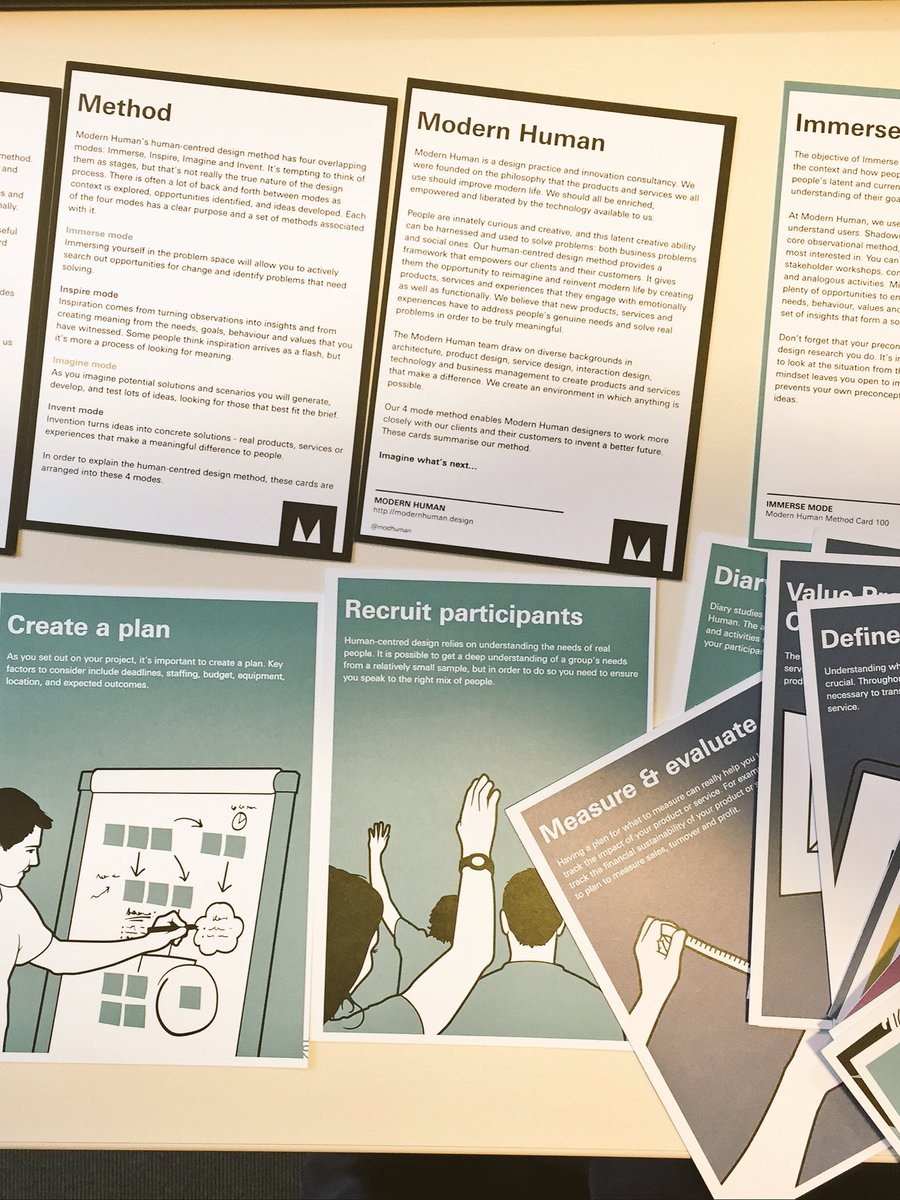
Modern Human Method Cards

Outside of the keynotes, I went to Creative Bravery: The Value of Embracing Failure (Paul Jervais-Heath) which was really interesting! Paul runs a design practice and innovation consultancy. In his own words, “I know how to design stuff!” His company, Modern Human, provided delegates with some cards that are really helpful in visually showing the various steps he uses to design things.

Key things that stood out to me from his session included using the ‘How might we?’ principle. Turn your findings into questions You would use this when analysing your results.
‘Create a concept’ was something else Paul talked about. He argues that the concept needs to be a clearly articulated idea outlining the features or benefits of the product/ service. 

Paul suggested borrowing from the film pitch idea, eg. Alien was pitched as ‘Jaws on a spaceship’ whereas the Spacefinder project he was involved with was described as ‘TripAdvisor’ for study space.’ It makes the concept/ idea more relatable to line managers/ decision makers. This is probably something we could do?   

I also attended a talk by Eva-Christina Edinger, from the University of Zurich, entitled Speak, friend and enter: Labyrinths, symbolic spaces and gated communities in university libraries. Eva does Library research but from a sociologist's point of view and took delegates on a walk-through her findings.

Knowledge of the existence of the library. I found it really interesting when Eva began by saying that in Germany at least, libraries exist to provide free access to knowledge thought and culture. She explained that lots of universities are not like this, they are hidden and kind of secret. Even when the libraries are in public open spaces, she found that people aren’t always aware that the building is a library! Libraries with windows seemed to fare better as they made it visible to those outside.

Access to the library - a gated community. Eva found that most libraries she studied forced users to pass a gate to be part of a ‘special’ community. Participants in the study felt privileged to use the library as not everybody can walk in.

Orientation and navigation within the library. Users reported that understanding the ‘library language’ is challenging which can created social exclusion. Libraries were described by some as ‘labyrinths’. Many libraries have multiple floors, further complicated by lettered sections. There are often different exits and entrances. Mental maps drawn by users show confusion. Eva asked how can we improve orientation and navigation in our libraries? And she also noted one library that had created digital maps hadn’t thought to make them mobile friendly, so not really fit for purpose considering the proliferation of mobile devices.

Symbolic spaces - place identity. Eva’s research showed that library users often use the same place in the library again and again. Users like making a miniature office in the library. Association with other scholars. It’s definitely a challenge to try and create this kind of space for users whilst not realistically being able to offer this to everyone.

Take home messages. Make libraries visible! The entrance of the library needs to be where it can be seen and good tools for indoor navigation including visible, non-cryptic shelfmarks, would be appreciated. Eva says that we should know our users and use friendly language and strive to create human-centred spaces not merely buildings full of books.

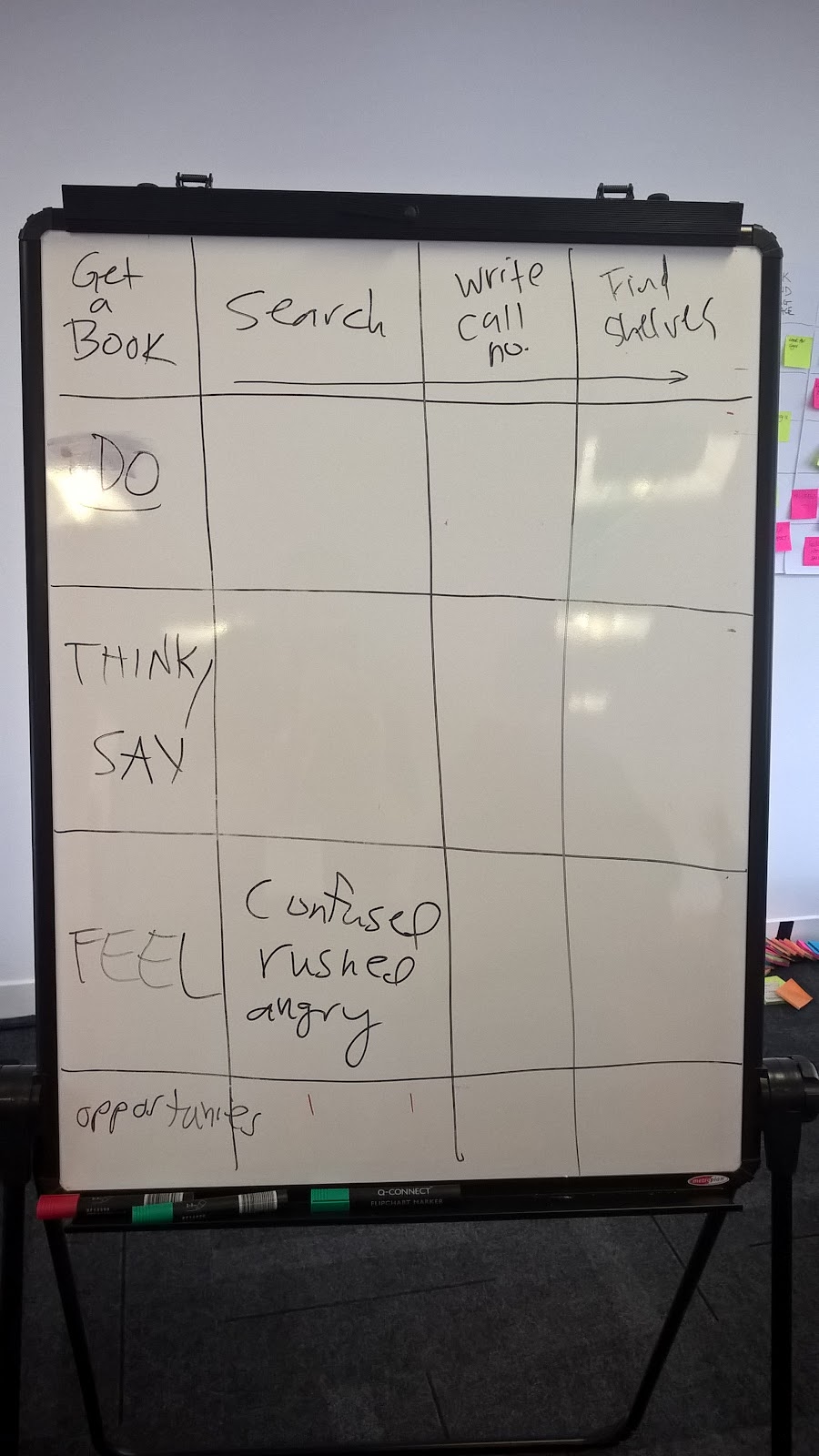
Journey map template laid out by Matthew
On the second day of the conference, I attended a User Journey Maps workshop, hosted by Matthew Reidsma.  

Matthew, like Donna, gave a keynote last year, however this year, he was tasked with a more practical session introducing us to user journey maps.

Matthew explained that user journey maps are like empathy maps. They enable you to think about what your user feels when they use a product, service or anything you offer them. The way he presented user journey maps was by considering first which persona or profile of a particular user group or personality type you are going to use. So you would do multiple user journey maps for different personas. The beauty of user journey maps is that the aim is to map every step, what the user is doing, thinking, feeling, saying etc.

To the right is the template we were working with that forces you to consider as many steps as possible when mapping out a user's experience. On the vertical axis you would have rows stating do, think/ say, feel and then opportunities. And along the horizontal axis you would write the steps (as many as you can think of) of the user journey. You would then fill in the sections or use post-its which are easier to move around. 

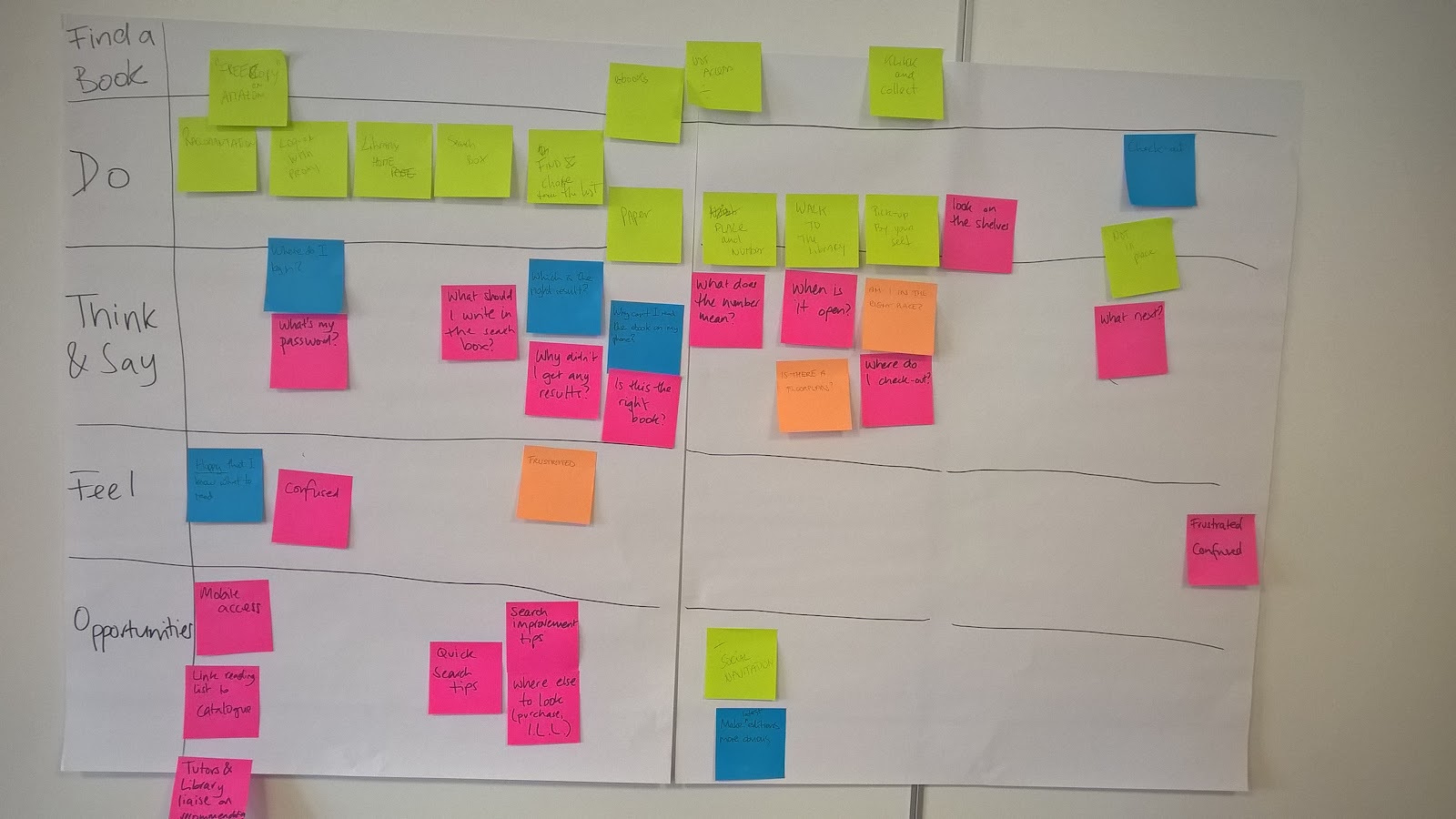
We used a simple example and mapped the journey of looking for a book in an academic library. You can see the map we did in the picture below. When we were discussing in our groups, we thought that you could do touchpoint tours (where the user takes you on a tour of the space).
I think the big takeaway messages from this session is that doing something like a user journey map can highlight the pain points within our service and forces you to keep asking the question ‘How can we make something less frustrating?’

WP_20160624_14_40_43_Pro.jpg
Journey map attempt from our team


Team Advocacy Challenge

The informal and interactive nature of UXLibs means it’s not really like any other conference I’ve been to. As part of attending, we are all put into teams for a challenge!

In teams of 9, we had to prepare a 7-minute pitch on a specific advocacy theme. In my team’s case it was on the theme of ‘recruitment’, recruiting participants for our research project. My team didn’t win but it was fun meeting new people and working together on the challenge.

In a really short space of time, (2ish hours) we formulated an idea that we thought (still think!) might be workable! We called it ‘The Pool’ and the idea was to, in collaboration with the Student Union, create a pool of students who we can draw upon as participants and/ or recruiters whenever we’re thinking about conducting some ethnographic research. We even started to consider long-term goals of ‘The Pool’ such as ethnography being a normal part of university life at York and we also considered the prospect of trying to build it into appropriate modules at appropriate times much like we are considering with digital literacy skills.


You can read more conference reviews on the UXLib site http://uxlib.org/conference-reviews/

P.S.

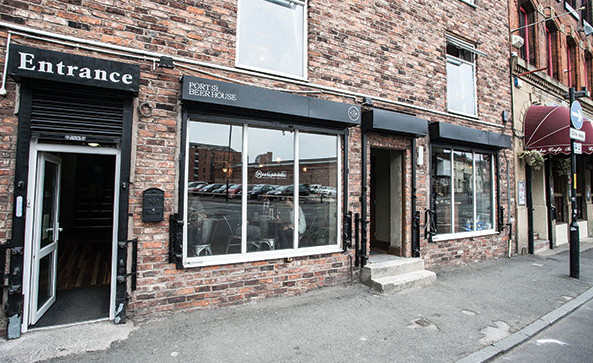
For fans of beer, Port Street Beer House is a must when in the Northern Quarter of Manchester. It was a great place to have discussions and debates about the EU!