Showing posts with label embedding ux. Show all posts

June 26, 2019

Embedding UX

By Ned Potter, Academic Liaison Librarian 

At UXLibs IV, Michelle Blake and I presented on embedding UX at York and trying to make it part of our culture. We then wrote up the article for the UXLibs Yearbook, and the Open Access embargo period has now come to an end so please go and have a read! You'll find the article here in the White Rose repository, freely available to download.

UX methodology is becoming more firmly established in the Library sector, moving from novelty to maturity. The article focuses on how do we've tried to ensure that our internal processes, systems, and ethos support this, and make UX truly part of our daily ‘business as usual’, rather than being a perpetual project... 

If you're interested, our slides from the conference are here:


To give you a flavour of the UXLibs yearbook article, here's an excerpt:

Top tips for embedding UX at your own institution 


We thought we’d end with five tips for embedding UX. We’re not trying to suggest we’re the experts here, or that we’ve perfected our strategy. But we have gone a long way to make UX part of the culture at York, and here are some of the things we consider to have been most important in achieving that:


You need buy-in from the top. 

Of course you do, this is news to no one. The key is to link UX to the existing aims and strategy of your organisation and management. People are much less likely to buy in to something in UX silo than they are to buy in to something which helps them achieve what is already on their agenda. Persistence is important too. Many institutions have found it’s a lot easier to get permission to diagnose problems through ethnography than permission to try and solve them through actual design changes - but don’t be discouraged, keep suggesting ways to improve things, and celebrate successful changes widely - and publicly. Which brings us neatly to...

Go beyond the walls of your own institution. 

The more you shout about your UX work to the wider world, the more it is appreciated inside your own institution. In a strange way, external validation can influence how valid something is considered internally, and if your work is out there and talked about this can help enormously.

Repeat after me: UX is not cool. 

The sooner UX is no longer framed as this hip new thing, the better. UX is a suite of useful tools that enable us to better know our users and improve our services for them. Nothing about that is faddish. UX is not trendy; UX is essential to improving library services.

Time is SO important for UX. 

It is important to be realistic about just how much time UX takes. We’ve found the 4:1 ratio - the idea that for every hour of fieldwork you’ll spend four hours analysing and making recommendations - to be remarkably accurate. It’s a messy business, ethnography, and only worth it because of how incredibly productive it can be. Investing time in staff so that everyone feels like they can truly understand and utilise these techniques is important. Time to keep up to date through networking at events, attending presentations, and reading the literature. Time for each project. Time to analyse results. Time to act on the data.

You get more impact from quality than you do from quantity. 

Embedding UX at an institution is not about trying to crowbar it into every facet of working life, in fact the opposite is true. Focus the way you use your resources and aim for true impact on the users of your service.

 UX truly takes root not because you do it all the time, but because when you do it you make a genuine impact, you truly learn, and things change as a result.


If you'd like to read the rest of the yearbook article, please download the article here!

November 19, 2018

[Video] UX keynote all about ethnography and design at York

By Ned Potter, Academic Liaison

This month I had the honour of giving the opening Keynote at the Stellenbosch University Library Symposium, the theme for which this year was User Experience.

I've travelled to South Africa for a conference before and it was one of the best professional experiences I've ever had, but this time I couldn't quite make the huge journey time work, with it being Autumn term, so we decided to do it virtually. We chose a mixture of recorded and live - I created a video, using Screencast-o-matic which I love, and then we did the Q&A live via Skype. I thought this was safer than trying to do the whole thing live and risk technology failure...

Although my colleagues and I have talked about UX at various events over the last three years, this was the first time we'd had the length of time afforded by a keynote, and my hosts had specifically asked to hear about the projects we've done at York - so essentially I pulled together all threads we often write about on this blog into one big presentation. I've embedded the video below and of course you're more than welcome to watch the whole thing if you'd like to! But given that people often have specific areas of interest around UX, here are some shortcuts to the various parts of the presentation:
  1. After the preamble there's an introduction to UX and ethnography. What it is (and isn't), the way it has spread across the industry, why it's so powerful. 
  2. Part 2 is a A timeline of UX at York. I discuss the various major UX-led projects we've done, our use and non-use of interns to help us, and the various ethnographic techniques we've used
  3. The massive up-scaling involved for the Understanding Academics project, plus some of our findings and the changes we made, are discussed next
  4. How we try to disseminate our findings and experiences is covered here
  5. Next I cover steering and guidance for UX. How it fits strategically, our UX Group which includes our UX book club, and so on
  6. Training and Support for UX is discussed here: our internal training sessions and the way we've been trying to bring this techniques to other parts of the University
  7. Finally, some tips for embedding UX at your own institution

There were some great questions afterwards not captured by this video. One of them was around the use of interns and the pluses and minuses of this. At York our first two UX projects were intern-led and we found this hugely beneficial for a number of reasons: someone having the time and space to focus on the fieldwork and analysis without other distractions was part of it, but so was having a completely fresh pair of eyes involved. There are advantages to non-library staff speaking to users as part of the fieldwork and bringing an outside perspective to the design recommendations.

That said, we did all the fieldwork for our two biggest UX projects to date ourselves, partly because it was such a good opportunity for as as staff to be learning about our users first-hand. It's also a fascinating process to be part of and a good opportunity for staff to learn new skills.

So without wanting to sit on the fence, there are good arguments both for using interns and for doing everything yourself...

______________________

Thank you so much to everyone at the Conference for inviting me and allowing me to present virtually. It was fun to put together.

November 06, 2018

Building the Fabrik Wall

By Ned Potter, Academic Liaison Librarian 

At the start of the academic year we reached a significant milestone in our use of UX at York (about which you can read many, many more posts elsewhere on this blog). We made our first major purchase as part of a re-design that came directly from an ethnographic project - woohoo!

We bought a sound-absorbent wall made of 'Fabriks' - it works like giant Lego, looks pretty cool, and controls the acoustics of the environment around it.

Here's what it looks like:

The Fabrik Wall as seen from the front

The Fabrik Wall as viewed from 'inside' it
To get the context to all of this we need to go back to 2017.

The UX Space Project

During 2017 we undertook the UX Space Project: ethnographic User Experience research into how the Morrell Lounge is used and how it might be improved. This is the area you see as you enter the Library at York - on average around 3,000 people pass through this every single day, making it perhaps the busiest area on either campus. At peak times there's around 7,000 entries.

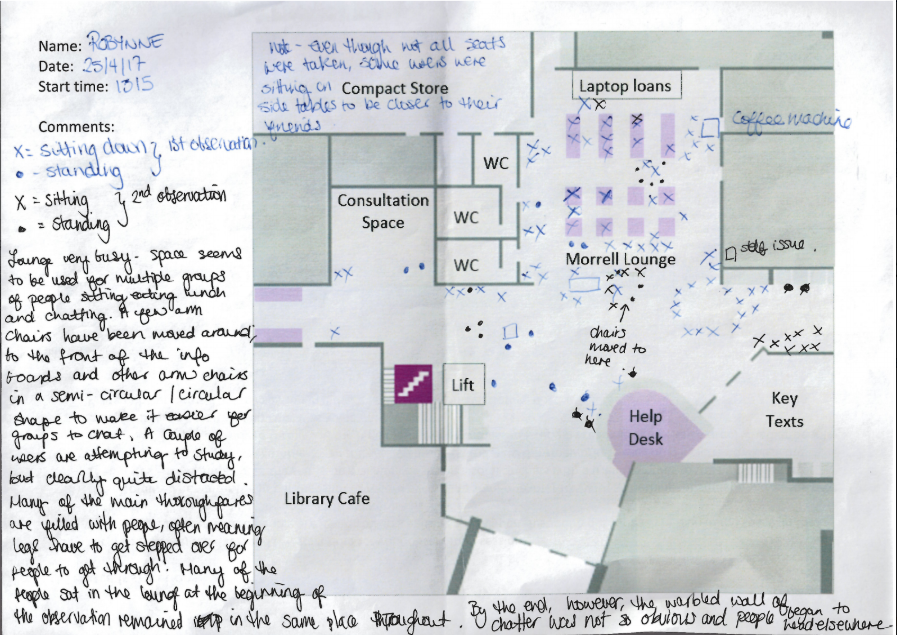
The fieldwork consisted of more than 40 sessions of behavioural mapping. We actually had to modify the 'standard' way we'd done observation like this before, because the area was simply too busy to track people's routes through the space. That element was removed from the list of responsibilities, but we made other tweaks too: for the first time we used a template map of the space (based on our floorplans), we put a definition of the AEIOU framework on the back along with other guidance to remind people what they were looking for, and left space for notes on the map itself.

Here's an example of the map and notes from one observation session:


A behavioural map with notes 
The fieldwork was undertaken by Customer Services staff (each of whom had individual training before their first session) and they were absolutely brilliant at capturing key info, and then feeding into the design process to find solutions too. All CS stuff kept notes of their thoughts on the space when working at the desk too, so we built up a picture of how the area was used even on days when we didn't have a Behavioural Mapping session planned. This turned into a massive 19-page Google Doc, which also included feedback from students and staff as it came in.

The initial phase of fieldwork lasted 6 months. The project identified problems including the area being too loud for those wishing to seek guidance at the Help Desk, it being unsightly to visitors as students are sprawled on the floor, and fundamentally the space not being used as we intended.


Design Prototyping

We ruled out trying to change the way the space was used, early on in the process. Instead we wanted to change the space to better suit the way it has been adopted by students and staff: this included swapping furniture with other areas of the Library to suit the way people congregate in groups, which was our first proper attempt at design prototyping. The changes we made went down so well, getting so much positive feedback (we had people emailing the library just to tell us how much they liked it!), that following another round of observational fieldwork we ended up leaving the temporary furniture in situ. It's still there now, although long term we'd like to improve the space further - we have a full design ready to go, based on all the research and suggested changes we've come up with, but it will cost a lot of money to realise.

Most costly of all we really wanted some kind of acoustic baffling to both contain the sound and make the entrance lobby a visually arresting sight with which to greet our regular users and visitors. We went through several rounds of a bidding process to try and win some Alumni funding to make big changes to the space - in the end the 'YuFund' scheme provided us with the funds to purchase what we're calling the Alumni Wall that you saw at the start of this post, made of special sound-absorbent ‘fabriks’ to change the acoustics of the space. And the acoustic difference is absolutely remarkable, significantly reducing the noise spilling from the Lounge, and in particular better enabling staff and students to converse at the Help Desk. Many staff have commented on the effect this has had - it is now noticeably easier to help people with queries - and the students like it too: ’Wow I really like it!’ one returning student exclaimed, coming to the desk especially to tell us… It also looks fantastic, and gives the whole area a more cohesive feel.

The whole project felt really exciting to be part of. It involved people from different teams in the Library working together, which is always good, and the Alumni Office (and the Students' Union) were really enthusiastic about what we were doing. Ultimately we were able to make a significant change to the space, and overall it works much better for both students and staff than it ever has before.

Finally, here's a short time-lapse video of its assembly:


June 06, 2018

Embedding UX and Ethnography at York

By Ned Potter, Academic Liaison Librarian

Michelle Blake and I presented at the amazing UXLibs IV Conference today, about our approach to trying to move into a more mature phase of UX - something truly embedded in the culture, rather than a bolt-on, a silo, or a fad.

I've adapted the slides below slightly to include more text on screen - hopefully this gives you some idea of how we've gone about things. Any questions, we're very happy to talk about it more...