April 19, 2017

Northern Collaboration User Experience (UX) Learning Exchange 2017


 By Robynne Eller, Assistant Librarian


“What people say, what people do, 
and what they say they do are entirely different things”


- Margaret Mead

The Northern Collaboration UX Exchange took place at the University of Huddersfield's state-of-the-art archive facility at the Heritage Quay. The choice of venue offered the perfect setting for a creative day of discussion and the chance to showcase a selection of what some Northern universities have been up to in terms of their approach to UX in their libraries.

#NCLXUX - Review of the day:

A wide range of UX topics were covered during the Learning Exchange, presentations given by speakers from institutions across the north of England. The day was introduced by UX expert, Andy Priestner, who reiterated the benefits of UX in university libraries, as well as breaking down the barriers of users who believe they are “Not good at libraries".

Some of the topics from other speakers surrounded usability issues of library websites, UX for distance learners, to the use of ethnographic studies used to observe user behaviour and use of space in academic libraries. Some of the talks given on the day can be found on Slideshare, which offers a snapshot of some of the themes and projects discussed. Storify was also used to show all Twitter feeds during the event, which were buzzing throughout the day!
Using social media to keep the UX conversations going!


A major theme that ran through the talks, was how ethnographic survey methods, specifically attitudinal surveys and behavioural mapping was used, in order to help understand users at a deeper level. For instance, at Teesside University, behavioural and cognitive mapping (as well as a Twitter photo competition!) helped inform how library furniture was used, showing furniture was being used in somewhat different ways by users than originally envisaged!

Communicating with users using social media: Teesside’s photo competition


It was also great to see that most of the universities were communicating with users through means of a “graffiti” or “feedback” wall, which have proved to be very responsive and positive in all cases where it has been utilised. Insights from the Open University were also quite useful in terms of their outreach to users who would access their services remotely, rather than visiting their library in person. From all the presentations given, it was clear that even smallest of UX changes held a significant impact for users and one of the key messages in achieving such changes is to not fear failure.


We even created our own graffiti walls to share UX ideas!


Following the talks, one of the most enjoyable aspects of the days was the opportunity to have open discussions with a range of other library staff from other HEI libraries. Seeing different projects from a range of different institutions made for some interesting discussions which enabled us to share ideas, be informed and inspired. We were also given a tour of the archives at Huddersfield, which was an excellent finish to the day!

Strategic Marketing in academic libraries?

It was enlightening to see how academic libraries are viewing UX as a marketing exercise, both in terms of research approaches and consideration of the a library’s long-term marketing cycle. I believe that this allows institutions to showcase what they are really good and marketing services which hold value for its users.

Additionally, such approaches allows academic libraries to keep their services fresh, relevant and exciting whilst continuing to have regular conversations with their users and colleagues to continually improve. Applying such an approach allows for specific questions to be asked and for users to be heard, so a suitable response can be made. As such, from the presentations, it is clear that a range of ethnographic methods are vital in achieving a better understanding in what users need most from their library services.


UX at York: What are we doing?
We've make quite a number of tweaks as a result of ramping up our UX recently, which did not go unoticed during the UX at York talk. But what are we doing now? As a part of the UX Space Project, we have recently been carrying out a series of ethnographic surveys in the Morrell Lounge and Raymond Burton study space. The aim of carrying out this type of survey is to gain a better understanding how spaces within the Library are used, the data of which is hoped to inform further stages of the Space Project.


The observations will be carried out over a twelve month period from February 2017 by staff members from IT, IS and CSA teams in 15-minute observations once a week per team. Within each 15 minute slot, user activity is observed and marked on floor plans using the AEIOU framework and changes to activity or new interactions are subsequently noted. Notes and thoughts are typed up later. Further to our observations, we have also asked staff members who notice spaces being used in a particular way at other times to report these to the UX Space Project group.

 
Example of an observation plan

Robynne’s take home messages:

  • Even small tweaks to a service can be significant
  • There is no such thing as “I’m not good at libraries”
  • Attitudinal surveys and behavioural methods are particularly useful when used in tandem with one another
  • Do not be afraid to fail
  • Ethnographic studies can be used to inform bigger changes

I would recommend anyone interested in UX to attend any collaboration events to keep up to date with what's going on in the world of UX. Seeing how York implements strategies within a Northern context was very informative - it will be exciting to see what the future holds for UX in libraries in the North and the rest of the UK. Huddersfield was also a great host for the event and I particularly enjoyed the tour of their archives too afterwards!



April 12, 2017

Northern Collaboration: UX Learning Exchange (#nclxux)

By Ned Potter, Academic Liaison Librarian 

A few of us working on UX projects at York attended a really excellent Northern Collaboration event in March, held at the University of Huddersfield. It was so useful to hear people sharing the results and (user) experiences, and I also gave a short talk on York's own UX projects so far.

Huddersfield Uni library has done an AMAZING job at Storifying the tweets from the day which you can read here. The slides from Andy Priestner's pretty explosive keynote are not yet online but the Storify gives you a good flavour of the talk and the key messages. Personally it was the kind of talk I wished everyone who works in my institution could attend, it was brilliant.

Most of the rest of the slides are on the Northern Collaboration Slideshare page, except mine which were already uploaded on my own Slideshare page, and are embedded below:


UX at York: starting small and scaling up (#nclxux) from Ned Potter


I also recorded the talk so will make a video that combines the PowerPoint and the audio at some point. 

Between the Storify and the Slideshare links you can get a good feel for the content of the day so I won't go through it talk by talk here, but I did want to list some of the things that particularly struck me from the day: 

  • "We would rather be wrong than uncertain." I've heard Andy refer to this Dan North quote before but I was glad to hear it again because it is SO very true. It really does explain a lot of the barriers around implementing both ethnographic feedback mechanisms and the changes subsequently designed based on the feedback. 
  • Behavioural versus attitudinal research. I've not quite had this properly articulated in my head until now. Attitudinal research is about what users think and say, and we do a lot of it in libraries. Behavioural research is about what users actually DO, and there is a big difference between this and what they say they'll do! So we need more of it. 
  • "I don't really think about the library all that much." I was already sold on surveys not being overly useful before Andy's keynote, but he had a brilliant slide about what people say versus what they are probably thinking (captured in one of Alison Sharman's tweets here) in surveys. The last of these examples was in response to the question 'Have you got any other comments?' - they're probably thinking 'I don't really think about the library all that much' - this really struck a chord with me. Even if they use the library a lot they don't think about it overly, so any survey answers that ask for a level of detail they've not already invested in our services will elicit an answer that is literally CREATED for the purposes of the survey. People will put something just to put something. 
  • People are awful at predicting future behaviour - and this includes their own. 
  • UX is possible at a distance! I've been asked about this at York before and never been able to satisfactorily answer it: can we use ethnographic techniques with distance learners? Keren Stiles' talk was so useful in setting out exactly how to do this, and she was kind enough to send me a follow-up email with more info in too - I now feel like we're equipped to try this stuff out for ourselves. 
  • My feelings on surveys and focus groups following this day (which features some talks in favour of them, some very much not) are as follows: 

    Surveys and Focus Groups are not without value, but the importance we place on them in academic libraries is disproportionate to their efficacy... 
Thanks to Alison and everyone else at both Huddersfield University and Northern Collaboration who made the day happen - more like this please! 

April 04, 2017

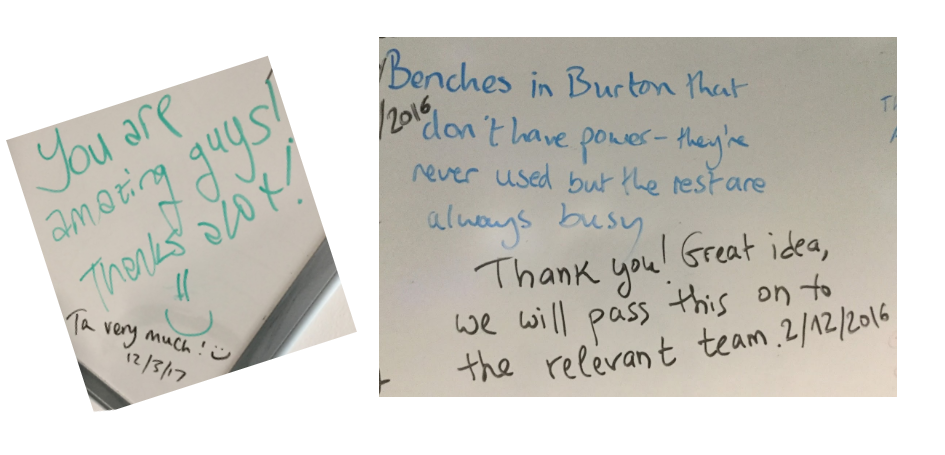
The Feedback Wall - Complaints, Compliments & Conversations with our Users

By Lydia Harris, Customer Services Supervisor 

In August 2016 I was asked to lead a project into the development and implementation of a ‘Feedback Wall’ - a board in the entrance to the library that is there for our users to write their comments/thoughts/queries to us on and, in turn, for us to respond to them however we see fit. Here’s a rundown of the whys and wherefores of the project and where we’re at now.

So why, oh why, did we do it?
It’s simply just an additional way to engage with our users alongside our more established feedback channels  - comments cards, email, social media etc - and as much as I’d like to say it’s a new earth-shattering idea that’s about to revolutionise the industry...It’s clearly not. Other academic libraries have been using similar techniques to gain insight and feedback about what people think of their services/products for years (I was spoiled for choice just with a quick google) so while we may have been late to the party - it was important that we didn’t miss it altogether.


How, oh how did we do it?

The setup is pretty easy; our users grab a pen from reception, write down their thoughts and an Information Assistant (IA) acknowledges and/or responds on a daily basis. To differentiate between user comments and our responses users write in any colour, we respond in black only. The IA takes a photo of this exchange using and uploads it to a shared folder for use at a future date. When the board gets full, an IA will erase the oldest reponses to make way for new ones. Job done; the wall went live on Sep 1 2016.

That’s it. Easy huh?..

In the next three months we had over 150 comments. Up to March 2017 we’ve taken over 275 photos...and counting. The word is out - and the word is all over the wall…

So given how popular it’s been what can I tell you about it all six months on…

The good
It’s almost too obvious to mention (but I will); we get an awful lot of lovely comments, and in a world where everyone is so quick to tell us when something is rubbish it’s really nice when users feel compelled to tell us when it’s good – one of the nicest things that’s started to happen is the suggestions for improvement:

There is a remarkable lack of offensive material or defacing the wall. Lord knows it’s an act of will for me not to do a juvenile and childish scrawl on it every time I pass by but the students are much more grown up than me. We do get some curious comments (more of that later) but on the whole, it’s all kept above board.


The bad

Ah, the power of a bad review should never be underestimated; we also get a few not so great comments, but, reassuringly, I’m yet to see one that pertains to the staff. However, while it’s wonderful that staff care about our services enough for negative comments to affect them, we do need to keep it in perspective - the good far outweighs the bad...and, quite honestly,  most of the comments have been about other student behaviour, the space or ‘value added services’ e.g. the costa coffee or vending machines not our core services or resources.


It can also be tiresome for staff to repeat the same thing, particularly things that aren’t going to change. However, these things come in waves and we have set up a Feedback Wall FAQ wiki page to help with some stock answers  for those pesky repeat-offenders.


...Sorry, childish joke.

The ugly...well, the interesting bits really; stuff we hadn’t thought about…


You’ve created a monster!
It’s popularity! It’s a bit of a victim of its own success. It’s clearly a hit with our users and what I’ve found really interesting is the level of engagement with an analogue medium in a digital world. Maybe there’s a visceral satisfaction in actually physically writing the words in your own hand, maybe because it’s anonymous but immediate (unlike comment cards - where we ask for contact details and get back in touch), maybe it’s just a novelty - in a world of online commentary, is the ‘retro’ nature of the feedback wall actually refreshing and inviting to a generation raised on a steady diet of click-bait, meme-ery and  twitterature? Who knows...but whatever the reason it’s taken off quicker than Usain Bolt and Ballyregan Bob* in race to the last Mcnuggets (other nuggety treats and their respective purveyors are available) **.

One Feedback Mechanism to rule them all.
It’s had quite a significant impact our traditional forms of communication with users and has become the primary source of our feedback, which I certainly didn’t really consider  - we have recorded all these photos in these folders without really going much further at this point or extrapolating meaningful data/themes out of it so it’s had implications in not just in how we record feedback but more importantly - what we do with it.

We’re all mad here, Alice...
They do love to put some out there stuff up there but that’s actually a really nice unexpected side-effect. The very fact that our community of users are comfortable enough to ‘bants’ (I believe that’s the technical term) with each other and us is a great thing. It helps break down any perceptions of an adversarial relationship between staff and students and builds on us developing a community and culture of approachability and inclusiveness.

We’re gonna need a bigger board...
So what next? Well, it shows no signs of slowing and there’s no going back now so is there a better way of us capturing the feedback and responding? We’re now looking at ways of ensuring this info gets passed on and followed up by the right team/person, so themes and patterns can be identified and actions decided. How we communicate back to our users what we’ve done is equally important so we’re adding an obvious - ‘You Said, We Did’ board to complement the wall so users can ‘track’ the progress of their suggestions and comments. We could also look at the use of mobile boards to see if the location has a noticeable effect on the types of comments we’re getting.

But while we have a really good think about what the future holds in developing this resource further, in the meantime,  it ain’t going anywhere and one thing remains clear - the last thing any of us will be doing is ignoring the writing on the wall.


* Ballyregan Bob was arguably one of the best greyhounds to ever grace the racing circuit. So much so after his death in 1994 he was exhibited in the Natural History Museum in Tring.

**Lazy and out-of-date reference to Bolt’s predilection for the poultry-based morsels in the lead up to inevitable Olympic glory.